Search: keyword:notso
|
|
|
|
|
Sort:
id
Format:
long
Filter:
(all | no meta | meta)
Mode:
(words | no words)
|
|
|
|
|
|
| |
|
| BP876 |
| Precise sorting of potential examples vs. not so. |
|
| |
|
|
|
|
COMMENTS
|
Left Bongard Problems do not have to sort all relevant examples; if they would leave some border cases unsorted, it just has to be clear precisely which examples those would be.
Often a precise divide between values on a spectrum comes from intuitively "crossing a threshold." For example, there is an intuitive threshold between acute and obtuse angles. Two sides of a Bongard Problem on opposite ends of a threshold, coming close to it, are interpreted as having precise divide between sides, right up against that threshold. |
|
|
CROSSREFS
|
See BP508 for the version with links to pages on the OEBP instead of images of Bongard Problems.
Adjacent-numbered pages:
BP871 BP872 BP873 BP874 BP875 * BP877 BP878 BP879 BP880 BP881
|
|
|
KEYWORD
|
hard, notso, challenge, meta (see left/right), miniproblems, creativeexamples, assumesfamiliarity, structure, presentationinvariant
|
|
|
WORLD
|
bpimage_shapes [smaller | same | bigger]
zoom in left (bpimage_shapes_exact_sort)
|
|
|
AUTHOR
|
Aaron David Fairbanks
|
| |
|
|
| |
|
| BP894 |
| Examples fit solution (once it is known) relatively obviously vs. examples fit solution in subtle or complex, harder-to-see ways. |
|
| |
|
|
|
|
COMMENTS
|
One left and one right example with each solution are shown for help.
This BP is fuzzy for multiple reasons. How obvious it is that an example fits a rule is subjective. Also, somebody could read the simplicity of all included examples as part of a Bongard Problem's solution. For example, the more obvious version of "square number of dots vs. non-square number of dots" could be interpreted as "square small number of dots arranged in easy-to-read way vs. non-square small number of dots arranged in easy-to-read way."
Whether this Bongard Problem solution would categorize an image of itself left or right depends on the difficulty of the solutions of the mini-Problems. |
|
|
CROSSREFS
|
See keyword help.
See keyword hardsort.
Adjacent-numbered pages:
BP889 BP890 BP891 BP892 BP893 * BP895 BP896 BP897 BP898 BP899
|
|
|
KEYWORD
|
fuzzy, abstract, notso, subjective, meta (see left/right), miniproblems, creativeexamples, presentationmatters, assumesfamiliarity, structure, contributepairs
|
|
|
WORLD
|
boxes_bpimage_three_per_side [smaller | same | bigger]
|
|
|
AUTHOR
|
Aaron David Fairbanks
|
| |
|
|
| |
|
| BP897 |
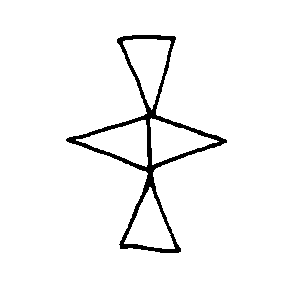
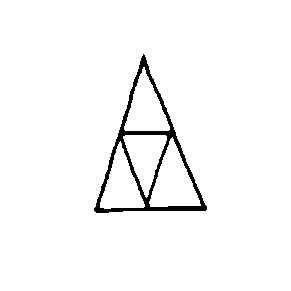
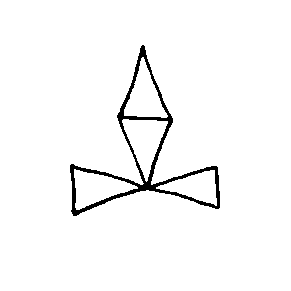
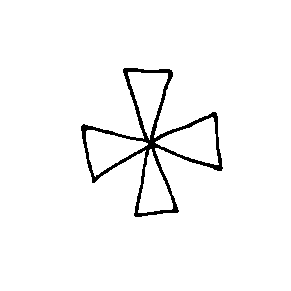
| Wide angles connected to narrow angles vs. not so. |
|
| |
|
| |
| |
|
|
| |
|
| BP898 |
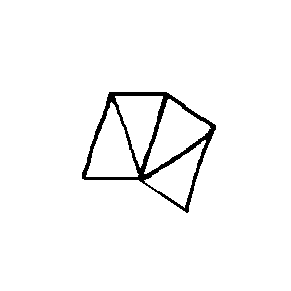
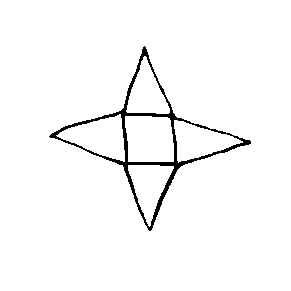
| Can fold into tetragonal disphenoid ("isosceles tetrahedron") vs. cannot. |
|
| |
|
| |
| |
|
|
| |
|
| BP905 |
| Graph can be redrawn such that no edges intersect vs. not so. |
|
| |
|
| |
| |
|
|
| |
|
| BP915 |
| Finite number of dots vs. infinite number of dots. |
|
| |
|
| |
| |
|
|
| |
|
| BP928 |
| All subsets of a collection vs. not. |
|
| |
|
| |
| |
|
|
| |
|
| BP946 |
| Can be constructed using 2 identical copies of an image (full overlapping not allowed) vs. not so. |
|
| |
|
|
|
|
COMMENTS
|
"Full overlapping not allowed" means you cannot overlay an image onto itself without moving it; if this were allowed all images would be sorted on the left. The copies can be moved around (translated) in 2D but can not be flipped or rotated.
There are examples on the right drawn with thick lines, and these could be created by copying an image with slightly thinner lines and moving it over a tiny amount. If you fix this issue by saying "the copy has to be moved over more than a tiny amount" then the Bongard Problem is perfect but not precise, but if you fix this issue by saying "interpret the figures as made up of (infinitesimally) thin lines" then it's precise but not perfect. - Aaron David Fairbanks, Jun 17 2023 |
|
|
CROSSREFS
|
Adjacent-numbered pages:
BP941 BP942 BP943 BP944 BP945 * BP947 BP948 BP949 BP950 BP951
|
|
|
KEYWORD
|
nice, notso, creativeexamples
|
|
|
AUTHOR
|
Leo Crabbe
|
| |
|
|
| |
|
| BP956 |
| Nested pairs of brackets vs. other arrangement of brackets (some open brackets are not closed or there are extra closing brackets). |
|
| |
|
|
|
|
COMMENTS
|
Examples on the left are also known as "Dyck words". |
|
|
REFERENCE
|
https://en.wikipedia.org/wiki/Dyck_language |
|
|
CROSSREFS
|
Adjacent-numbered pages:
BP951 BP952 BP953 BP954 BP955 * BP957 BP958 BP959 BP960 BP961
|
|
|
KEYWORD
|
easy, nice, precise, allsorted, unwordable, notso, sequence, traditional, inductivedefinition, preciseworld, left-listable, right-listable
|
|
|
CONCEPT
|
recursion (info | search)
|
|
|
AUTHOR
|
Aaron David Fairbanks
|
| |
|
|
| |
|
| BP979 |
| It is possible to deduce the contents of the missing square vs. not so. |
|
| ?
 |
|
|
|
|
|
COMMENTS
|
All examples show grids of squares with an image in each square, such that there is some "rule" the images within the grid obey. The "rule" can be about how the images relate to their neighbors, it can involve the position of the images in the grid, and it can involve properties of the grid considered as a whole. One square from somewhere along the edge of the grid is removed.
Intentionally left out of this Bongard Problem (or left as sorted ambiguously) are cases in which there is no clear rule, or it is not possible to deduce what the intended rule is without seeing more squares (e.g. EX8097). Due to this choice to omit those kinds of examples from the right, another acceptable solution is "it is possible to deduce the contents of the missing square once the underlying rule is understood vs. not so." |
|
|
REFERENCE
|
https://en.wikipedia.org/wiki/Raven%27s_Progressive_Matrices |
|
|
CROSSREFS
|
BP1258 is very similar: whether ALL squares can be deduced from the rest.
Adjacent-numbered pages:
BP974 BP975 BP976 BP977 BP978 * BP980 BP981 BP982 BP983 BP984
|
|
|
KEYWORD
|
nice, notso, structure, rules, miniworlds
|
|
|
CONCEPT
|
convey_enough_information (info | search),
choice (info | search)
|
|
|
WORLD
|
grid_of_images_with_rule_one_on_edge_missing [smaller | same | bigger]
|
|
|
AUTHOR
|
Aaron David Fairbanks
|
| |
|
|
Welcome |
Solve |
Browse |
Lookup |
Recent |
Links |
Register |
Contact
Contribute |
Keywords |
Concepts |
Worlds |
Ambiguities |
Transformations |
Invalid Problems |
Style Guide |
Goals |
Glossary
|
|
|
|
|
|
|
|
|
|